

Wedding Loan for Women in India: Eligibility, Costs and Safer Options
Planning a wedding can create a funding gap when venue, catering, travel, jewellery and family-related expenses arrive together. A wedding loan for women is generally not a separate nationwide loan category. In most cases, it is a regular unsecured personal loan marketed for marriage or wedding expenses.
Women can apply in their own names, including unmarried women, if they satisfy the lender's income, credit, age, employment and documentation requirements. A male co-applicant, parent, fiancé or spouse is not a universal legal requirement. However, a lender may offer or require a co-applicant under its own underwriting policy.
Before applying, compare the complete borrowing cost and test the EMI against your post-marriage budget. Do not rely only on a promotional rate, advertised maximum amount or instant-approval message.
Quick Answer
A woman in India can generally apply for a wedding loan in her own name if she meets the lender's criteria. The product is usually a personal loan for wedding-related spending and is often unsecured, so property or gold may not be required as collateral. The central-government schemes reviewed do not establish a universal government wedding-loan scheme exclusively for women. Rates, fees, loan amounts, tenure and eligibility vary by lender and borrower profile.
Before accepting credit, review the lender's latest Key Facts Statement (KFS), annual percentage rate (APR), sanction letter, fees and repayment terms.
Key Takeaways
- A wedding or marriage loan is usually a personal loan marketed for wedding expenses, rather than a distinct women-only product.
- An unmarried woman may apply independently; marriage proof and a male co-applicant are not universal requirements.
- Women-specific concessions are lender-specific. A women-focused webpage does not by itself confirm a lower rate or higher loan limit.
- Calculate affordability using expected post-marriage income, expenses, existing EMIs and emergency savings.
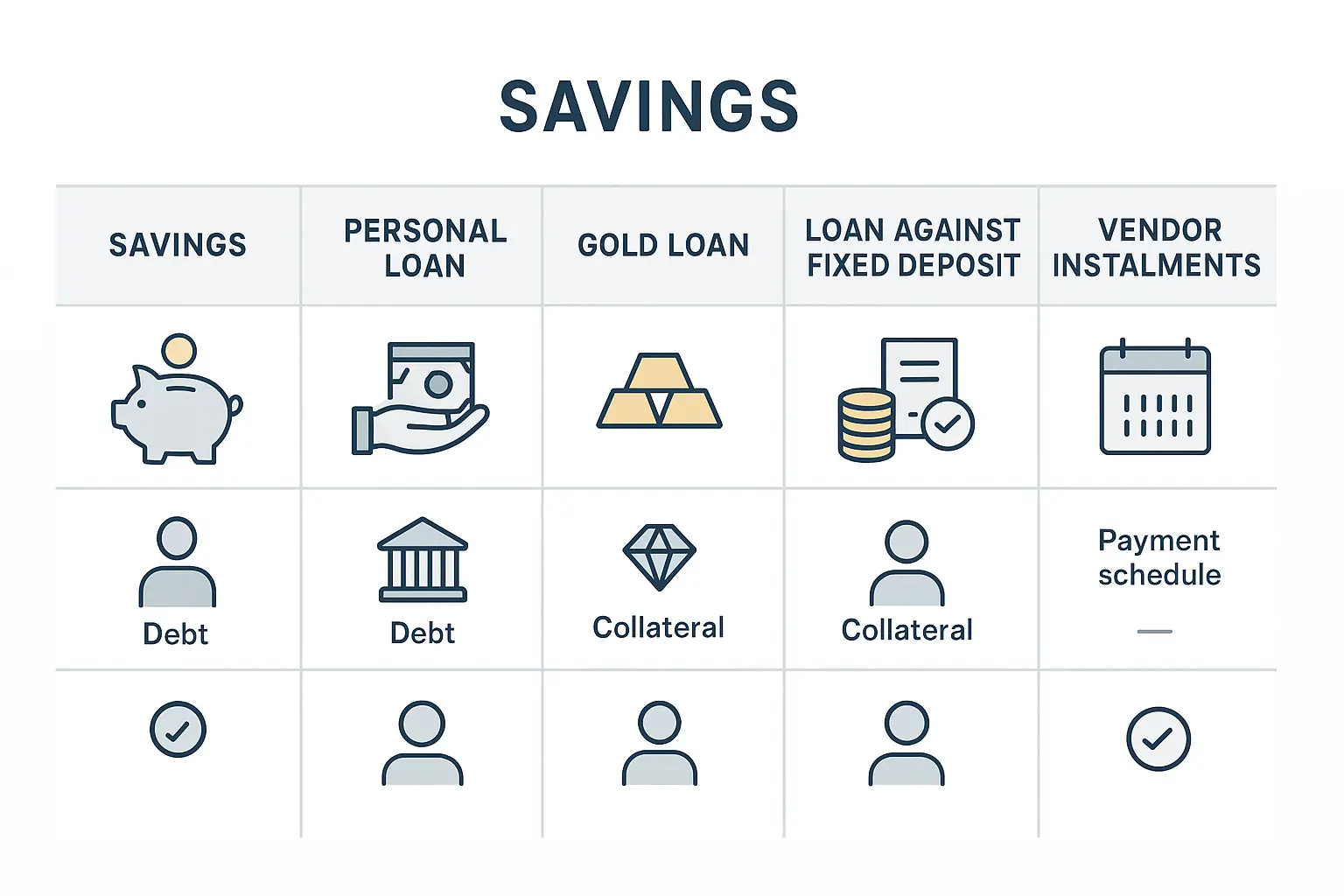
- Compare savings, vendor instalments, a gold loan and a loan against a fixed deposit before choosing unsecured borrowing.
- The borrower named in the loan agreement remains responsible for repayment, even if family members or both partners use the money.
Table of Contents
- What is a wedding loan for women?
- Is there a government wedding-loan scheme for women?
- Can an unmarried woman apply alone?
- Eligibility and documents
- Rates, fees and EMI calculation
- How to apply safely
- Personal loan versus other funding options
- Should you take a wedding loan?
- Frequently Asked Questions
What Is a Wedding Loan for Women?
A wedding loan for women is commonly a personal loan promoted for expenses connected with a marriage. Depending on the loan agreement, permitted uses may include:
- venue or banquet booking;
- catering;
- decoration;
- photography and videography;
- accommodation and travel;
- wedding clothing and attire; and
- jewellery or rings.
An unsecured personal loan does not normally require the borrower to pledge property, gold or a fixed deposit. Instead, the lender assesses income, employment or business stability, credit history, existing obligations, banking conduct and other internal criteria.
The label can be useful when searching for a product, but it should not be treated as proof that the loan has special benefits for women. Read the underlying personal-loan terms and disclosures.
For a small, simple or court wedding, first calculate the actual shortfall. Borrowing the maximum amount offered can turn a manageable expense into long-term debt.
Is There a Separate Government Wedding-Loan Scheme for Women?
The central-government schemes reviewed do not establish a universal women-specific personal loan for wedding expenditure. The Department of Financial Services lists schemes such as PMMY/MUDRA, Stand-Up India and JanSamarth, but these address business, entrepreneurship or other defined purposes rather than general wedding spending. See the Department of Financial Services schemes listing.
Some women-focused schemes should not be confused with wedding finance:
- Stand-Up India supports eligible women and SC/ST entrepreneurs establishing greenfield enterprises. It is a business-loan scheme, not a general marriage loan. Details are available on the official Stand-Up India page.
- PM MUDRA Yojana provides credit for eligible income-generating micro-enterprises. It is not a personal loan for wedding expenses. Official information is available through this PIB release on PM MUDRA.
- DAY-NRLM women self-help group credit is intended for livelihood and group-credit support, not a general individual wedding loan.
- NBCFDC schemes, including women-focused livelihood or microfinance options, have defined beneficiary and income conditions and should not be presented as wedding-loan products. Refer to the NBCFDC loan scheme information.
State marriage-assistance programmes may exist for particular categories or income groups, but they vary by state and are not automatically loans. Verify any state benefit through the concerned government department before relying on it.
Can an Unmarried Woman Apply Alone?
Generally, yes. An unmarried woman may apply for a personal loan intended for wedding expenses if she meets the lender's eligibility requirements. The official ICICI Bank marriage-loan information states that women can apply subject to the applicable criteria and describes the product as a personal loan for wedding-related expenses.
The research reviewed did not establish a universal requirement for an applicant to provide a marriage certificate, wedding invitation, venue booking, fiancé's consent or a parent's guarantee. A particular lender may still request information or documents based on its product and underwriting process.
Marriage status is different from repayment capacity. A lender can assess a single woman's own income, liabilities, employment history and credit report. A co-applicant may be considered if the applicant needs additional eligible income or a higher amount, but this is a lender-specific underwriting decision rather than a general legal requirement.
The Reserve Bank of India states that lenders must not discriminate on grounds of sex, caste or religion, subject to permitted weaker-section schemes. This does not mean every woman receives a lower rate, higher limit or relaxed credit standards.
Do Banks Offer Special Concessions to Women?
A lender may create a women-focused product, promotion, fee concession or targeted programme, but no universal concession should be assumed.
A women-related label may refer to:
- a separate product page;
- a limited-period promotional offer;
- a processing-fee waiver;
- a pre-approved offer for an existing customer;
- a business or livelihood scheme; or
- general marketing aimed at women borrowers.
The reviewed ICICI material confirms that women can apply but does not promise a universal women-specific lower rate or higher limit. The reviewed HDFC page includes a women-related navigation category but does not establish a universal concession for all women taking a marriage loan. Any women-focused benefit advertised by another lender should be checked on the current official product page.
Women-Specific Benefit or Marketing Label?
Ask the lender to confirm the benefit in writing:
- Is it a lower interest rate, fee waiver or another concession?
- Does it apply to a regular personal loan used for a wedding?
- What income, employer, credit or customer conditions apply?
- Is the offer temporary or available throughout the loan tenure?
- Is the benefit shown in the sanction letter and KFS?
A promotional headline is not a substitute for contractual terms.
Eligibility and Documents
There is no India-wide minimum salary, CIBIL score, loan amount or employment-tenure requirement for every wedding loan. Lenders may consider the following:
- age at application and at loan maturity;
- salary, professional or business income;
- employment stability or self-employment history;
- existing EMIs, credit-card dues, rent and recurring commitments;
- credit history and recent enquiries;
- salary or business bank-account conduct;
- residence and KYC details; and
- the lender's internal risk, geography and customer policies.
Salaried Women
A lender may request:
- PAN;
- Aadhaar or another accepted identity and address document;
- recent salary slips;
- bank statements showing salary credits;
- Form 16 or other income proof, where requested;
- employer and employment details; and
- photographs, application forms and consent forms, where required.
ICICI's official page lists salary slips and bank statements among the documents for salaried applicants. Requirements can differ for existing, pre-approved and new customers.
Self-Employed Women
Possible documents include:
- PAN and KYC documents;
- income-tax returns;
- audited or certified financial statements;
- GST filings, where applicable;
- personal and business bank statements;
- business or office address proof;
- proof of business continuity; and
- registration or licence documents, where requested.
The lender decides which documents are necessary. Do not assume that every lender requires a fixed business vintage or a particular number of GST returns.
Is a CIBIL Score Required?
For an unsecured personal loan, lenders generally review the applicant's credit report and score, but the lender—not TransUnion CIBIL—makes the lending decision. CIBIL describes its score as a three-digit summary ranging from 300 to 900 and explains that the report includes payment history, credit accounts and lender enquiries. Read the CIBIL explanation of credit scores and reports.
There is no universal RBI-mandated score of 700 or 750 for every wedding loan. A stronger credit profile may help with eligibility or pricing, but it cannot guarantee approval. Multiple full applications within a short period can create hard enquiries, so compare options before submitting repeated applications. Checking your own CIBIL report does not itself reduce the score. RBI directions also provide for one free full credit report, including score, from each credit information company once per calendar year; confirm the current process before requesting it.
Rates, Fees and EMI Calculation
Interest rates and fees vary by lender, product and borrower profile. Avoid treating any advertised rate, fee or loan amount as a guaranteed offer. “Starting from” and “up to” figures may not apply to a particular applicant and can change.
The total borrowing cost may include:
- interest;
- processing fee and GST on taxable charges;
- documentation or verification fees;
- optional insurance or bundled products;
- late-payment or penal charges;
- mandate or bounce charges; and
- prepayment, foreclosure or administrative charges.
For applicable retail term loans, regulated entities must provide a Key Facts Statement containing important cost information. For digital lending, APR must be disclosed upfront and charges not included in the KFS cannot be added later. Review the lender's KFS and agreement, and refer to the RBI material on Key Facts Statements and annualised costs.
Penal charges should be reasonable and disclosed clearly. They should not be treated as an undisclosed addition to the interest rate. Check the applicable lender policy and current RBI requirements before accepting credit.
Illustrative EMI Example
This is a calculation example, not a lender quote:
- Principal: ₹5,00,000
- Assumed annual interest rate: 14%
- Tenure: 36 months
- Monthly reducing-balance EMI
- Fees, GST, insurance and taxes excluded
Approximate result:
- EMI: ₹17,089 per month
- Total repayment: ₹6,15,197
- Total interest: ₹1,15,197
The EMI formula is:
EMI = P × r × (1+r)^n ÷ [(1+r)^n − 1]
Here, P is the principal, r is the monthly interest rate and n is the number of instalments. A longer tenure may reduce the monthly EMI but generally increases the total interest. Use a reliable EMI calculator to test different assumptions, then confirm the lender's figures in the KFS.
How to Apply Safely
- Prepare a detailed wedding budget and identify the exact funding shortfall.
- Decide the maximum EMI that remains manageable after marriage.
- Check the applicant's credit report and correct errors before applying.
- Compare official lender disclosures without submitting multiple full applications.
- Verify the regulated bank or RBI-registered NBFC behind any digital platform.
- Review the KFS, sanction letter and loan agreement before accepting.
- Check the APR, total repayment, processing fee, GST, late charges and prepayment terms.
- Complete KYC or video KYC only through a trusted lender channel.
- Confirm the disbursal account and repayment mandate.
- Save digitally signed documents and set up EMI reminders.
RBI advises consumers to avoid loan apps received through unsolicited SMS or social-media links and to verify an app's association with a regulated lender through the lender's official website. Do not pay an advance “approval fee” to an unknown intermediary.
If an application is rejected, avoid immediately applying everywhere. Review income stability, existing obligations, documentation and recent enquiries first.
Personal Loan Versus Other Funding Options
| Option | Security | Potential suitability | Main risk or question |
|---|---|---|---|
| Personal wedding loan | Usually unsecured | Stable income where no asset should be pledged | Can the post-marriage budget absorb the EMI? |
| Gold loan | Eligible gold pledged | Borrower has gold and a predictable repayment plan | What happens if missed payments lead to auction risk? |
| Loan against FD | Fixed deposit placed under lien | Temporary liquidity is needed and an FD exists | Is preserving the FD worth the borrowing cost? |
| Savings | No debt | Wedding is planned and savings can cover the cost | Will the emergency reserve be depleted? |
| Vendor instalments | Contract-specific | Reputable vendors offer clear staged payments | What are the cancellation, refund and late-payment terms? |
| Reduce or postpone the wedding budget | No new debt | Borrowing would fund discretionary upgrades | Which costs can be removed or delayed? |
A gold loan is secured by pledged gold, while a loan against an FD encumbers the deposit. Neither is automatically cheaper or better. Compare APR, fees, tenure, repayment structure and the consequences of default. SBI's official gold-loan information illustrates the collateral nature of that product. Terms for loans against deposits vary by bank and deposit type.
Should You Take a Wedding Loan?
Borrowing may be worth considering only when the shortfall is clearly defined and repayment remains affordable after marriage. Before applying, check that:
- the loan is not funding an open-ended or status-driven budget;
- existing EMIs, rent, insurance and credit-card dues are included;
- an emergency fund will remain available or can be rebuilt;
- possible relocation, job change or career break has been considered;
- the couple and families agree who will pay each EMI; and
- the wedding can proceed without another fresh loan.
Be especially cautious about borrowing for jewellery. Jewellery may be important to a family, but it does not automatically generate income. Debt can remain after the wedding even when the purchase has no repayment source.
A borrower named in the loan agreement remains responsible even if parents pay the EMI, both families use the money or the wedding is cancelled. A co-applicant or joint borrower may also be jointly liable. CIBIL states that a guarantor is responsible for ensuring repayment. Put any family or couple repayment arrangement in writing, including who receives the funds, who pays the EMI and what happens if the wedding is postponed or cancelled.
Prepayment and Foreclosure
Do not assume that prepayment is always free. Charges depend on the rate type, lender category, product purpose, sanction date and applicable rules. Check whether the loan is fixed or floating, whether a lock-in period applies and what administrative charges may be payable.
For floating-rate EMI-based loans, ask the lender how rate changes could affect the EMI or tenure and what prepayment options are available under the applicable framework. The sanction letter and KFS should be treated as the primary documents for the specific offer.
Wedding Loan Checklist for Women
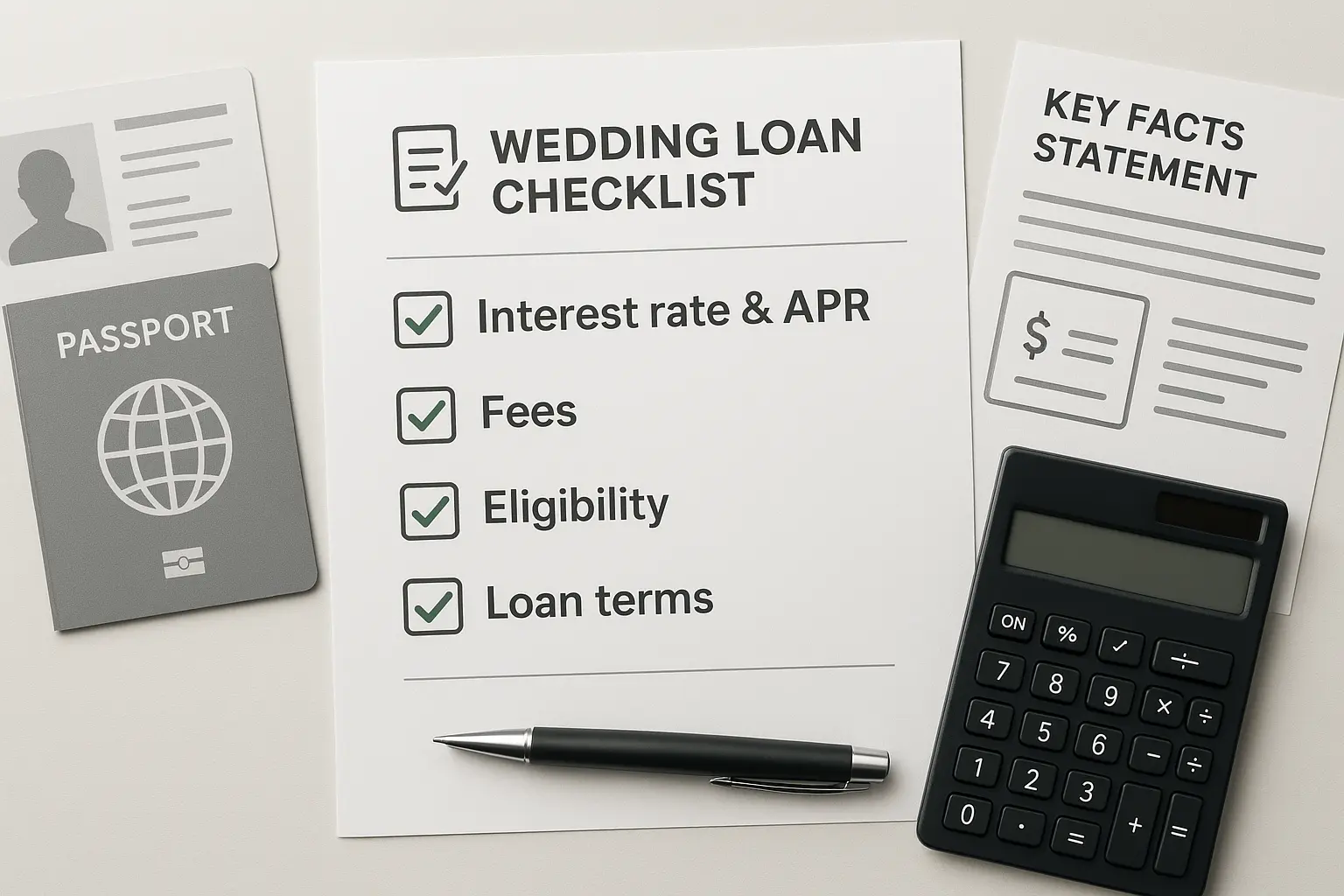
Before accepting an offer, confirm:
- The lender's legal name and regulated-bank or NBFC association
- Whether the product is a regular personal loan or a specific women-focused scheme
- Your sanctioned interest rate and APR
- Processing fee, GST and all other charges
- Total repayment and instalment schedule
- Fixed or floating rate structure
- Late-payment, bounce and penal charges
- Prepayment or foreclosure conditions
- Required documents and KYC process
- The account into which the loan will be disbursed
- Who is contractually responsible for repayment
- Whether the EMI remains affordable after marriage
- The latest KFS, sanction letter and loan agreement
Frequently Asked Questions
Can women apply for a wedding loan in India?
Yes. Women can generally apply for a personal loan marketed for wedding expenses if they satisfy the lender's eligibility criteria. Approval, pricing, loan amount and tenure depend on the lender and the borrower's profile.
Is there a separate government wedding-loan scheme for women?
The central-government schemes reviewed do not establish a universal women-specific personal loan for wedding expenses. Women-focused government credit schemes generally support entrepreneurship, micro-enterprises, self-help groups or livelihood activity and should not be treated as general marriage finance.
Can an unmarried woman take a personal loan for her own wedding?
Generally, yes, subject to the lender's criteria. An unmarried applicant does not automatically need a marriage certificate, fiancé's consent or a male co-applicant, although a lender may request documents under its own policy.
Is a male co-applicant compulsory?
No universal legal requirement was verified. A lender may permit or request a co-applicant when additional income is needed or its underwriting policy requires one. Anyone who signs as a co-applicant or joint borrower should understand their contractual repayment liability.
What is the minimum salary required for a wedding loan?
There is no universal minimum salary for all lenders. Income requirements vary according to the lender, employment type, existing obligations, credit profile and requested amount. Salaried and self-employed applicants should confirm the current criteria directly with the lender.
Can a wedding loan be used for jewellery or a court marriage?
A general-purpose personal loan may permit several wedding-related uses, but the loan agreement controls. Some lender pages describe use for simple or court weddings and jewellery; confirm the current contractual terms and consider whether borrowing for a non-income-generating purchase is affordable.
Final Guidance
A wedding loan for women can provide access to funds, but the word “women” does not automatically mean a lower rate, easier approval or a higher limit. Start with savings, planned family contributions, staged vendor payments or a smaller wedding budget where possible. If borrowing remains necessary, borrow only the defined shortfall, compare the full cost and plan repayment using post-marriage finances.
VowMoney provides educational wedding-finance guides to help couples estimate costs, calculate EMIs and compare different funding approaches. Use these planning resources before making a borrowing decision.
Educational note: This article is general financial education, not a loan offer, investment advice, legal advice or a guarantee of approval. Rates, fees, eligibility, loan limits, repayment terms, government schemes and regulatory requirements can change. Verify the lender's latest Key Facts Statement, APR, charges, sanction letter and conditions through official channels before accepting credit.