

Wedding Loan Calculator India: Estimate EMI, Interest and Total Repayment
Quick Answer
A wedding loan calculator estimates the monthly EMI, total interest and total repayment for money borrowed towards marriage expenses. Enter the amount you actually need to borrow—not the entire wedding budget—along with the annual interest rate and tenure. The result is an illustration, not a lender quote. Before applying, add processing fees and applicable taxes, compare the lender’s APR and Key Facts Statement (KFS), and check whether the EMI still fits after rent, existing EMIs, household setup costs and emergency savings.
Key Takeaways
- A “wedding loan” is generally a use-case label for a personal loan, not a universally separate loan category.
- Calculate the funding gap after savings and confirmed contributions, rather than automatically borrowing the full wedding cost.
- A longer tenure usually lowers the EMI but increases total interest.
- Processing fees, GST on applicable charges, insurance and foreclosure terms can make the actual cost higher than the calculator’s interest figure.
- An affordable EMI must work after marriage, not only during wedding planning.
How to Use a Wedding Loan Calculator
Use these inputs:
- Loan amount: the principal you plan to borrow.
- Annual interest rate: enter the rate per annum offered or illustrated by the lender.
- Tenure: enter the number of months over which you will repay.
- Charges, if supported: add processing fees, applicable GST, insurance and other disclosed costs separately.
The calculator should show the monthly EMI, total repayment through EMIs and total interest. A more detailed tool may also show an amortisation schedule, where each EMI is divided between principal and interest.
Try more than one scenario. For example, compare ₹3 lakh with ₹5 lakh, or a 36-month tenure with a 60-month tenure. The lower EMI may look comfortable, but it does not automatically represent the lower-cost option.
How Wedding-Loan EMI Is Calculated
For a standard reducing-balance loan with monthly instalments, the formula is:
EMI = [P × r × (1+r)^n] ÷ [(1+r)^n − 1]
Here:
Pis the loan principal.ris the monthly interest rate: annual rate ÷ 12 ÷ 100.nis the total number of monthly instalments.
With a reducing-balance loan, interest is calculated periodically on the outstanding principal. As principal is repaid, the interest portion generally falls and the principal portion rises.
The mathematical result can differ from a lender’s repayment schedule because of the disbursement date, first-EMI date, broken-period interest, rounding, fees deducted upfront, prepayment or changes in a floating rate. Treat the output as an estimate, not an approval or final offer.
Illustrative EMI Examples
The figures below use the reducing-balance formula. They are illustrative calculations, not market averages or lender offers.
| Loan amount | Rate | Tenure | Approx. EMI | Approx. total interest | Approx. total repayment |
|---|---|---|---|---|---|
| ₹2,00,000 | 18% p.a. | 24 months | ₹9,985 | ₹39,636 | ₹2,39,636 |
| ₹5,00,000 | 12% p.a. | 36 months | ₹16,607 | ₹97,858 | ₹5,97,858 |
| ₹5,00,000 | 15% p.a. | 36 months | ₹17,333 | ₹1,23,976 | ₹6,23,976 |
| ₹5,00,000 | 12% p.a. | 60 months | ₹11,122 | ₹1,67,333 | ₹6,67,333 |
| ₹10,00,000 | 12% p.a. | 60 months | ₹22,244 | ₹3,34,667 | ₹13,34,667 |
The ₹5 lakh example shows the tenure trade-off clearly. Extending repayment from three years to five years reduces the EMI by approximately ₹5,485, but increases total interest by approximately ₹69,476.
How Much Should You Borrow?
The amount you calculate should be the funding gap, not necessarily the entire wedding budget. A practical estimate is:
Required loan = wedding budget − savings allocated to the wedding − confirmed contributions + any remaining shortfall
For example:
| Item | Amount |
|---|---|
| Estimated wedding budget | ₹8,00,000 |
| Savings allocated to the wedding | ₹2,50,000 |
| Confirmed family contribution | ₹1,50,000 |
| Approximate funding gap | ₹4,00,000 |
Do not commit every rupee of savings to venue advances, catering, jewellery or photography. Keep a separate reserve for medical costs, relocation, a rental deposit or a temporary income disruption. The size of that reserve depends on your circumstances; the ₹50,000 sometimes set aside in a wedding budget is not a universal emergency-fund rule.
Family contributions should be treated as available funds only when they are confirmed. Do not build the repayment plan around an uncertain gift, bonus or promise of help.
For a broader estimate of wedding costs, you can use the wedding budget calculator India guide.
Check Affordability After Marriage
A calculator answers “What will the EMI be?” It does not answer “Will this EMI remain manageable?” Use this planning calculation:
Post-wedding monthly surplus = take-home income − existing EMIs − essential expenses − expected post-wedding costs − new EMI
Include rent or housing costs, insurance, medical expenses, travel, household purchases and support for parents. If either partner may leave employment temporarily, or if self-employed income varies, test the calculation against a weaker-income month rather than an unusually good one.
There is no universal RBI rule saying that your EMI must be a particular percentage of income. Lenders may assess income, existing obligations, employment or business continuity, credit history and their own internal risk measures, including FOIR. A calculator cannot predict approval from salary or CIBIL score alone.
If the proposed EMI leaves little room for emergencies, reduce the amount borrowed first. Removing a non-essential event, postponing an upgrade or increasing confirmed contributions is usually safer than stretching a short-lived wedding expense across several years.
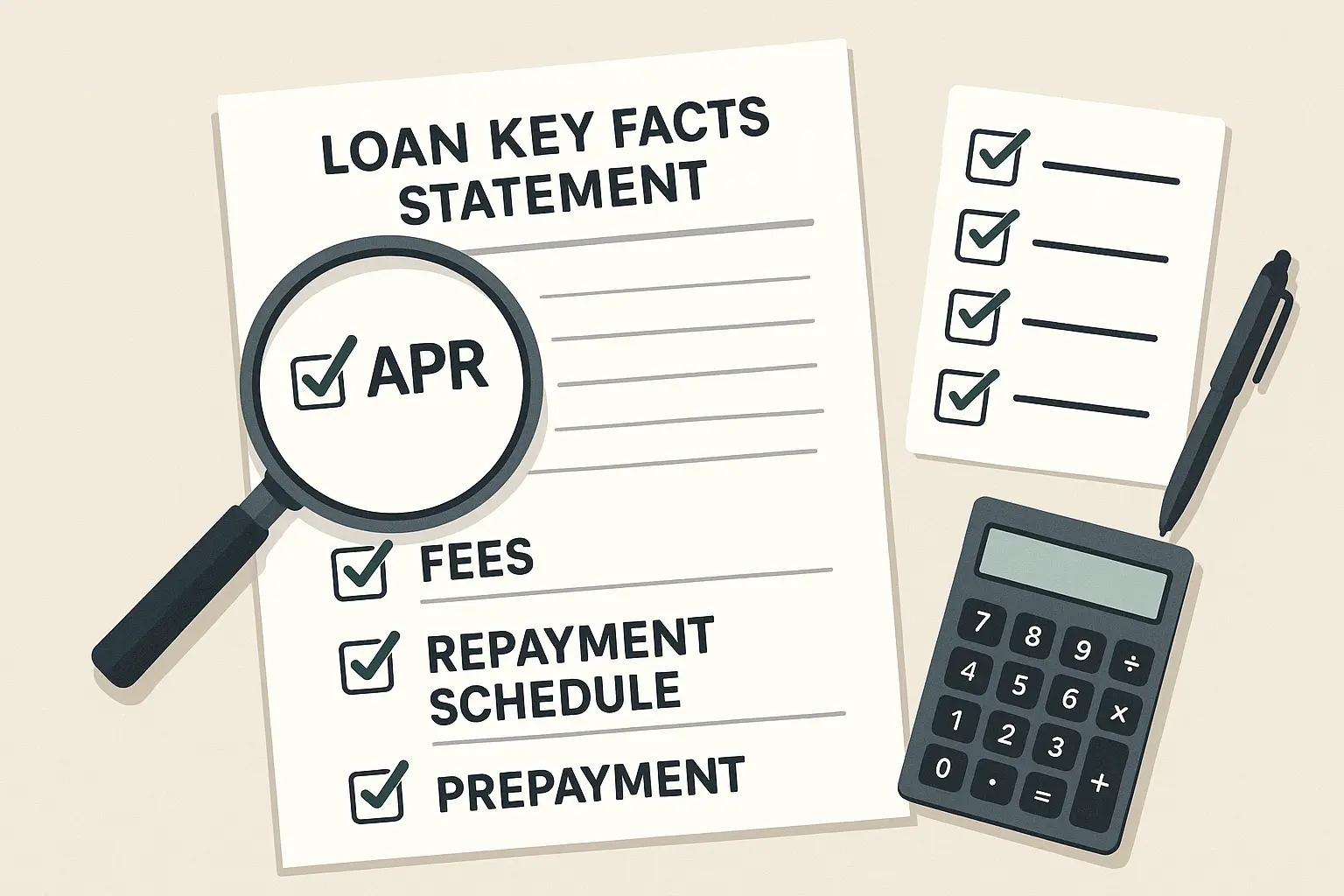
Fees, APR and the KFS
Basic calculators normally include only principal and interest. Check the lender’s current KFS and schedule of charges for:
- Processing and documentation fees
- GST or other applicable tax on lender charges
- Insurance, if optional or bundled
- Stamp duty or statutory charges, where applicable
- Mandate or repayment-instrument charges
- Late-payment, penal or EMI-bounce charges
- Part-prepayment and foreclosure charges
The RBI’s KFS framework requires applicable retail lenders to disclose the APR and an amortisation schedule. APR reflects the annual cost of credit, including interest and associated charges. In practical terms, two loans with similar headline rates can have different total costs once fees are included. Read the RBI guidance on KFS and APR before accepting an offer.
If charges are deducted upfront, the amount credited to your bank account may be lower than the sanctioned principal, while repayment may still be based on the agreed loan amount. Make sure the KFS states what you will receive, what you will repay and when each instalment is due.
Advertised “starting from” rates are not guaranteed offers. Final pricing and eligibility depend on the lender’s current policy and borrower assessment.
Alternatives and Safer Borrowing Choices
A wedding loan is generally marketed as an unsecured personal loan for expenses such as venue, catering, decoration, clothing, jewellery, photography, travel or accommodation. ICICI Bank describes its marriage loan in this way, while CIBIL lists weddings among possible personal-loan uses. Product terms still vary by lender.
| Funding option | Main benefit | Main limitation |
|---|---|---|
| Reduce the wedding budget | Avoids interest and new debt | Requires changes to plans |
| Use savings | No borrowing cost | Can weaken emergency reserves |
| Personal or wedding loan | Flexible use and scheduled EMI | Interest, fees and credit risk |
| Gold loan | Uses available gold as security | Gold may be enforced if dues are unpaid |
| Credit-card EMI | Convenient for smaller purchases | Can become fragmented across vendors and costly |
| Family borrowing | May avoid formal interest | Can create relationship and repayment tension |
For jewellery or other optional purchases, ask whether the expense can be reduced or delayed before comparing secured and unsecured borrowing. No option is automatically best; the right choice depends on cost, urgency, collateral, cash flow and repayment certainty.
You can also read our guide to marriage loan challenges and safer alternatives.
Eligibility, Credit and Repayment Checks
Lenders may consider credit history, income, existing debt, employment type, age, residency and internal policy. Salaried applicants may be asked for KYC documents, salary slips, bank statements and income evidence. Self-employed applicants may need bank statements, income-tax returns, financial statements and business-continuity documents. Requirements vary by lender.
Check your credit report before applying. Multiple applications can create lender enquiries, and missed EMIs can harm repayment history. CIBIL explains that lenders use the score and report alongside income and other information; no single score guarantees approval or a particular rate. RBI also requires eligible individuals to receive one free full credit report, including score, each calendar year.
A co-applicant is not merely a reference. Review the contract to understand joint repayment responsibility. A guarantor should also understand when the lender can call upon the guarantee and how default could affect them.
Before accepting any offer, verify:
- The regulated lender and official application channel
- APR, rate type and total repayment
- KFS, amortisation schedule and disbursal amount
- All fees, penalties and cancellation terms
- Minimum holding period and prepayment conditions
- The responsibilities of every co-applicant or guarantor
For a digital loan, RBI guidance requires applicable disclosures such as the APR and KFS, and digital lending apps should be connected to a regulated entity. Do not assume that every loan app has the same cooling-off or cancellation terms; check whether the rules apply to the specific product.
Prepayment and Tax
To estimate a prepayment saving, obtain the outstanding principal, calculate the interest remaining under the original schedule, then subtract any applicable prepayment charge and taxes. The prepayment amount itself is not the interest saving.
For individual borrowers, specific RBI protections may apply to floating-rate term loans taken for non-business purposes, while fixed-rate products may have lender-specific charges or conditions. Check the rate type, KFS, sanction letter and current schedule of charges before prepaying.
Do not assume a tax deduction for ordinary wedding-loan interest. Published Income Tax Department deductions focus on specific purposes such as house property and education loans, not a general personal loan used for wedding expenses. Verify your position with a qualified tax professional because tax rules can change.
Frequently Asked Questions
What is a wedding loan calculator?
It is a planning tool that estimates the EMI, total interest and total repayment for money borrowed towards wedding expenses. It does not approve a loan or guarantee a lender’s rate, fees or eligibility decision.
Should I enter my total wedding budget?
Usually, no. Enter the amount still required after subtracting savings and confirmed contributions, while retaining a separate reserve for post-wedding emergencies and household costs.
Does a longer tenure reduce wedding-loan EMI?
Usually, yes, when the principal and rate are unchanged. The trade-off is that the loan generally remains outstanding longer and total interest increases.
Can the calculator include processing fees and GST?
Only if the tool allows you to enter them separately. A basic EMI calculation includes principal and interest but not every lender charge. Compare the result with the APR and KFS.
What credit score is needed for a wedding loan?
There is no single score applicable to every lender. Credit history is assessed alongside income, existing obligations, employment or business stability and the lender’s internal policy.
Is there a tax benefit on a wedding loan?
Do not assume one. An ordinary personal loan used for wedding expenses generally does not have a dedicated income-tax deduction in the published guidance cited above.
A Safer Next Step
Run at least three scenarios: a smaller principal, a shorter tenure and the rate stated in the lender’s actual offer. Then compare the resulting EMI and total cost with your post-wedding monthly surplus. If the plan works only when every salary, bonus and family contribution arrives on time, reduce the borrowing before you sign.
For more guidance, explore VowMoney’s wedding loan EMI calculator guide and related wedding-finance resources.
Sources: ICICI Bank marriage loan information, CIBIL personal-loan guidance, RBI KFS and APR directions, RBI digital-lending guidance, and Income Tax Department Section 24 guidance.