

Marriage Loan Challenges in India: Costs, Risks and Safer Alternatives
A marriage loan can solve an immediate cash shortfall when the venue, caterer or photographer needs payment. But the wedding may last a few days; the EMI could remain part of the household budget for several years. That is the central challenge.
In India, a “marriage loan” or “wedding loan” is usually an unsecured personal loan marketed for wedding expenses, rather than a separate regulated loan category. The decision should depend on your post-marriage cash flow, existing debt, emergency savings and future goals—not on the maximum amount a lender is willing to approve.
Quick Answer
A marriage loan is not automatically a bad idea, but it is risky when it funds social-pressure spending, empties your savings or leaves little monthly surplus after marriage. Before borrowing, compare the complete cost in the Key Facts Statement (KFS), calculate the EMI against combined take-home income and essential expenses, and discuss repayment responsibility with your partner. If the plan works only while both incomes remain uninterrupted, reducing the wedding budget is generally safer.
Key Takeaways
- A marriage loan is generally an unsecured personal loan used for wedding expenses.
- Interest, processing fees, GST on applicable charges, penalties and add-ons increase the actual wedding cost.
- Loan approval does not prove that the EMI is affordable after marriage.
- Missed EMIs can affect credit history and may reduce future borrowing capacity.
- Use savings carefully, reduce discretionary costs and borrow only the minimum necessary amount.
What Is a Marriage Loan?
A marriage loan is usually a lender’s description of an unsecured personal loan used for wedding or family-event expenses. SBI and ICICI Bank list weddings among the uses of their personal-loan products, while Axis Bank describes its personal loan as unsecured.
That means the lender generally assesses factors such as income, credit history and repayment capacity rather than taking jewellery, property or a fixed deposit as collateral. Product names can differ, so read the sanction letter and KFS instead of relying on the label “wedding loan”.
The Main Marriage Loan Challenges
1. The total cost is higher than the wedding bill
The advertised interest rate is only one part of the cost. Check the amount actually credited to your account, EMI, total repayment and total interest. Also look for:
- Processing fee and GST on applicable fees
- Documentation or stamp charges, where applicable
- Late-payment, penal and mandate-bounce charges
- Foreclosure or part-prepayment charges
- Optional insurance or other add-ons
RBI’s KFS framework requires regulated entities to disclose important loan terms and applicable charges. For digital loans, the KFS should include the Annual Percentage Rate (APR), which reflects the all-inclusive cost of the loan. Two loans with similar interest rates may therefore have different total costs.
2. The EMI arrives after the celebrations end
After marriage, rent, relocation, household setup, insurance, support for parents and existing vehicle or education EMIs may compete for the same salary. A home purchase, childcare or one partner taking a career break can change the calculation again.
The useful question is not, “How much will the lender approve?” Ask instead: “What monthly surplus will remain after marriage, and can it absorb this EMI during a difficult month?”
3. Missed payments can affect your credit history
TransUnion CIBIL states that missed loan or credit-card payments can affect the CIBIL Score. Banks and financial institutions use credit history when assessing future applications.
Taking a personal loan does not automatically reduce your score. A new application can create a recorded enquiry and the loan adds a new debt obligation. The bigger risk is delayed or missed repayment. Multiple enquiries are recorded, although an enquiry does not itself mean that a loan was taken.
4. Future borrowing capacity may fall
An existing wedding-loan EMI becomes part of your monthly debt obligations. That may reduce the repayment capacity available for a future home or car loan. It does not guarantee rejection; the actual decision depends on income, existing EMIs, credit history, employment stability, banking history and the lender’s policy.
A lender-specific EMI-to-income condition is not a universal Indian rule. Treat every published ratio as product-specific and verify the current terms.
5. Income disruption does not pause the EMI
Job loss, relocation, delayed salary, self-employed cash-flow fluctuations or medical expenses can make a previously manageable EMI uncomfortable. The loan remains payable even if the wedding costs more than planned or one partner stops working.
Keep liquid savings for essential expenses, existing EMIs, the new EMI and urgent needs. Do not assume a future bonus, family contribution or second income will arrive exactly when required.
6. Easy credit can expand the wedding budget
Flexible-use borrowing can turn a manageable shortfall into a larger event: a bigger guest list, destination travel, luxury décor, designer clothing or additional ceremonies. Borrowing is harder to justify when it mainly protects the family from social embarrassment.
A modest, clearly budgeted shortfall is different from financing upgrades that can be postponed or removed. The safest amount to borrow is the minimum required after cutting non-essential costs.
7. Partners may disagree about liability
Before applying, discuss who is borrowing, who will pay the EMI and what happens if one income stops. Also disclose existing loans and credit-card balances. If a co-applicant is added, understand the shared contractual and credit consequences rather than treating the application as a formality.
Marriage by itself should not be described as automatically making one spouse liable for the other’s personal loan. Liability depends on the loan agreement and whether a person is a borrower, co-borrower or guarantor. Read the contract carefully.
How to Test Affordability
Prepare a post-marriage budget using:
Available monthly surplus = combined take-home income − essential expenses − existing EMIs − insurance − planned savings
Then apply three tests:
- EMI resilience: Can you pay if one income stops temporarily or an emergency raises expenses?
- Emergency-fund test: Will savings remain after venue advances, jewellery and other wedding payments?
- Goal-delay test: Will the EMI postpone a home purchase, insurance, investing, education savings or repayment of more expensive debt?
An illustrative calculation shows why tenure matters. Suppose the principal is ₹5,00,000, the annual interest rate is 14% and the loan uses a reducing-balance EMI. Fees, GST, insurance and other charges are excluded; this is not a lender offer.
| Tenure | Approx. EMI | Approx. total interest |
|---|---|---|
| 36 months | ₹17,089 | ₹1,15,197 |
| 60 months | ₹11,634 | ₹1,98,048 |
The five-year option lowers the monthly EMI but adds substantially more interest. Actual figures can differ because of lender calculations, disbursement timing, fees, taxes and rounding. You can use VowMoney’s wedding loan EMI calculator to examine the repayment trade-off before speaking to a lender.
What to Compare Before Borrowing
Use the current KFS, sanction letter and loan agreement to check:
- Net amount disbursed and repayment schedule
- Fixed or floating rate, APR and interest-calculation method
- EMI, total interest and total repayment
- Processing fee, GST and insurance or other add-ons
- Penal charges, bounce charges and late-payment terms
- Part-prepayment and foreclosure conditions
- Reset terms if the rate is floating
- Lender identity, grievance officer and escalation route
- Data permissions when applying digitally
RBI requires penal charges for default or non-compliance to be disclosed upfront and treated as penal charges rather than added penal interest. There is no universal cap on such charges, so the lender’s policy still needs to be checked.
Do not assume every personal loan can be prepaid without a charge. Terms differ by loan type and lender. RBI directions include specific provisions for certain floating-rate personal loans, but those provisions should not be generalised to every fixed-rate loan.
Alternatives to an Unsecured Loan
| Option | Main advantage | Main risk or limitation |
|---|---|---|
| Savings | No interest or EMI | Using all savings removes emergency protection |
| Smaller wedding budget | Removes borrowing cost | Requires difficult conversations and trade-offs |
| Family contribution | May reduce formal borrowing | Unclear expectations can create relationship stress |
| Gold loan | Secured borrowing may have a different structure | Pledged jewellery may be at risk if repayment fails |
| Loan against FD or investments | Uses an existing asset as security | Access to the asset may be restricted; terms and opportunity costs vary |
If family money is involved, record whether it is a gift or loan, the amount and the repayment expectation. A gold loan is not automatically safer: it replaces unsecured debt with the risk of losing pledged gold under the lender’s default process.
For online borrowing, verify that the lender is identifiable and regulated, receive the KFS before signing and avoid unidentified instant-loan apps. RBI advises consumers not to share KYC documents with unauthorised or unidentified apps. Digital lenders should disclose APR, charges, grievance contacts and need-based data practices.
Interest on a personal loan used for wedding expenses should not be assumed to qualify for a tax deduction. Income-tax deductions are purpose-specific; consult a tax professional for an individual case.
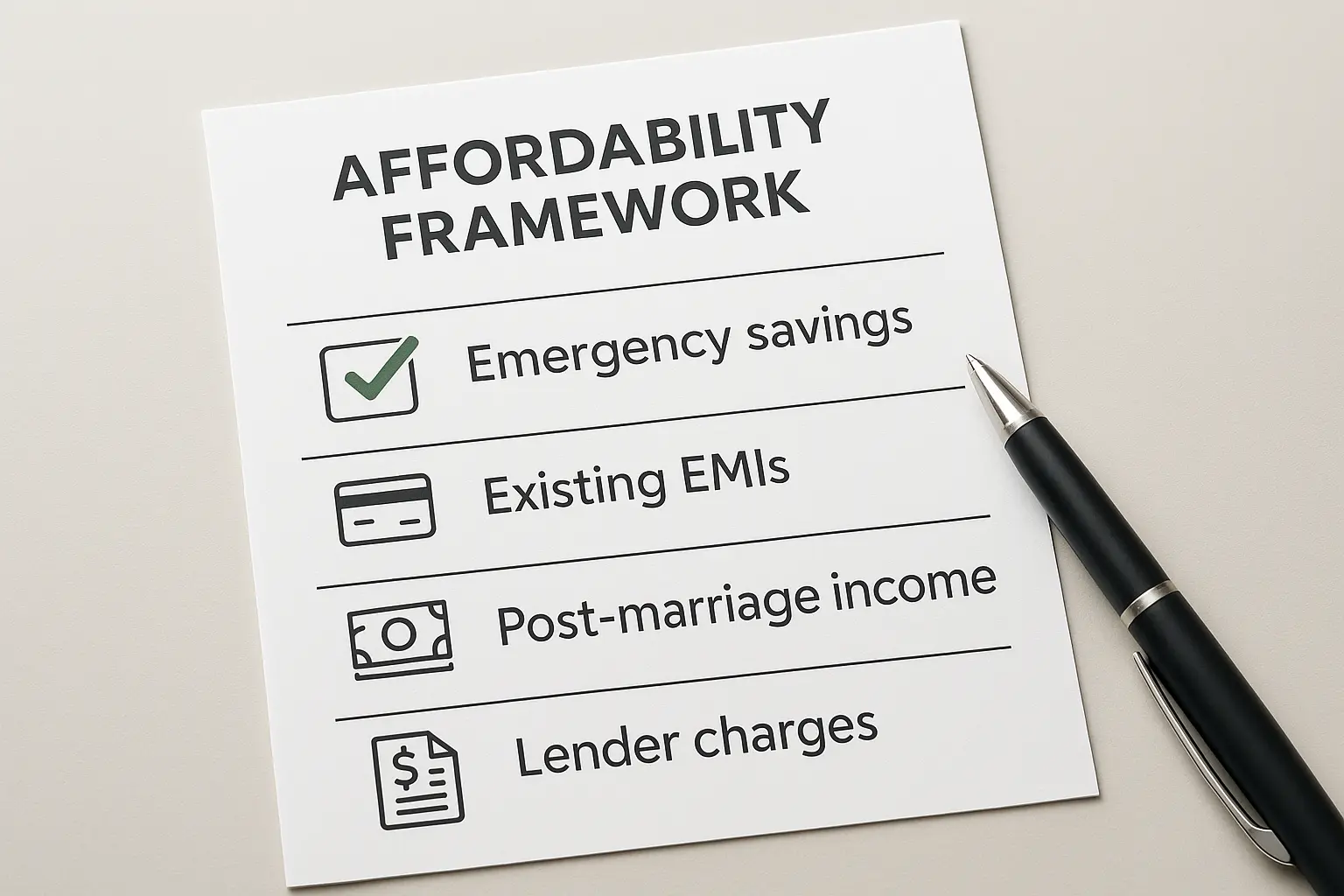
A Practical Decision Checklist
Consider borrowing only if all of these are true:
- The amount covers a defined, unavoidable shortfall.
- The post-marriage budget leaves a reliable monthly surplus.
- Emergency savings will not be exhausted.
- Both partners understand the borrower and repayment responsibility.
- The lender provides a clear KFS and agreement.
- The EMI will not seriously delay essential financial goals.
If any answer is no, reduce the event or postpone non-essential spending before applying.
Frequently Asked Questions
What is a marriage loan?
It is usually an unsecured personal loan marketed for wedding or marriage expenses. It is generally not a separate regulated loan category.
Is a marriage loan different from a personal loan?
Usually, not in its underlying structure. A lender may use “wedding loan” or “marriage loan” as a product description, but the applicable rate, fees and repayment terms must be checked in the lender’s documents.
Can a marriage loan affect CIBIL?
Missed or delayed EMIs can affect the CIBIL Score. The loan also becomes a new debt obligation, which may influence future lender assessments. Timely repayment is the key credit-management issue.
Can it affect future home-loan eligibility?
It may reduce the amount a lender is willing to approve because the existing EMI reduces available repayment capacity. It does not automatically prevent a home loan; the lender’s assessment and your overall finances matter.
Should I use savings or take a loan for wedding expenses?
Using savings avoids interest, but exhausting them can leave the household exposed to emergencies. Compare a smaller wedding budget and a limited use of savings while preserving a reasonable liquid reserve before considering borrowing.
What if the borrower loses their job after marriage?
The EMI generally remains due. Contact the lender early, review the agreement for available options and do not use another high-cost loan to cover instalments without a clear repayment plan.
Final Takeaway
A marriage loan can fill a genuine short-term gap, but it converts a one-time celebration into a long-term obligation. Calculate the post-marriage surplus, preserve emergency savings, compare the complete cost through the KFS and borrow only what is necessary. Explore VowMoney’s wedding-finance guides and calculator before committing to an EMI.