

How Do Wedding Loans Work in India?
If wedding expenses are higher than the money currently available, a wedding loan may appear to offer a convenient solution. But in India, a “wedding loan” is usually not a separate, standardised loan category. It is commonly a personal loan marketed for marriage-related spending.
Quick Answer
A wedding loan generally works like an unsecured personal loan. You apply to a bank, NBFC or lender-linked digital platform, provide KYC and income information, and undergo a credit and affordability assessment. If approved, the lender sanctions an amount at an applicant-specific rate and tenure. The money is usually disbursed to your bank account and repaid through monthly EMIs containing principal and interest. Before accepting, compare the APR, total repayment, net amount received, processing fee, late charges and prepayment terms in the lender’s latest Key Fact Statement (KFS) and loan agreement.
Key Takeaways
- A wedding or marriage loan is usually a personal loan for wedding expenses, but the actual agreement determines the product’s terms.
- Eligibility, interest rate, loan amount, documents, fees and approval timelines vary by lender and borrower profile.
- An EMI is only one part of the cost; compare APR, total repayment and the net amount you will receive after deductions.
- Parents, couples and co-applicants may be able to apply, subject to lender policy. Joint borrowers share repayment responsibility.
- Use borrowing only for a clearly identified funding gap and check that the EMI remains manageable after marriage.
Table of Contents
- What is a wedding loan?
- How do wedding loans work?
- Who can apply and what documents are needed?
- How are eligibility, interest and EMI decided?
- What is the total cost?
- How to compare lenders safely
- Alternatives and responsible borrowing
- Frequently asked questions
What Is a Wedding Loan?
A wedding loan is commonly a personal loan intended for expenses such as venue deposits, catering, decoration, photography, clothing, travel and accommodation. Depending on the lender’s agreement, it may also be usable for other lawful wedding-related costs, including jewellery or gifts.
However, do not assume that every lender permits every expense. Check for end-use restrictions, prohibited uses and any documentation requirements before accepting the loan. For example, ICICI Bank describes its marriage loan as a personal loan, but that is a lender-specific description rather than a universal legal definition.
The term may refer to different structures, including:
- An unsecured personal loan marketed for a wedding
- A pre-approved personal loan offered to an existing customer
- A secured loan, such as a gold loan or loan against a fixed deposit, used for wedding costs
- A cooperative-bank product with its own security, guarantor or marriage-related conditions
The loan agreement, KFS and schedule of charges matter more than the product name used in an advertisement.
How Do Wedding Loans Work in India?
The usual process is as follows.
1. Calculate the actual funding gap
Start with the complete wedding budget. Then subtract savings, confirmed family contributions, deposits already paid and other funds that are genuinely available.
The amount you borrow should be based on the remaining funding gap—not automatically on the total wedding budget. Also account for an emergency reserve and expected post-marriage expenses such as rent, relocation, insurance, healthcare and household setup.
A wedding budget worksheet can help you organise planned expenses before deciding whether credit is necessary.
2. Compare banks, NBFCs and digital channels
Before applying, compare the actual regulated lender and the complete cost of the offer. Review:
- Interest rate and whether it is fixed or floating
- Annual Percentage Rate, or APR
- Loan tenure and EMI
- Processing fee and applicable tax
- Net amount that will be disbursed
- Late-payment and bounce charges
- Part-prepayment and foreclosure conditions
- Customer support and grievance channels
- Data permissions for digital applications
A headline rate described as “starting from” is not a guaranteed rate for every applicant.
3. Submit the application
The application usually asks for personal details, requested amount, tenure, employment or business information, bank-account details and KYC documents. Depending on the lender and channel, verification may include PAN, identity checks, bank-account verification, credit-bureau access and electronic consent or e-sign.
4. Undergo credit assessment
The lender reviews income, employment or business stability, existing debt obligations, credit history, banking information and its internal risk criteria. The lender may also assess the proposed loan amount and tenure against your repayment capacity.
There is no universal RBI-prescribed CIBIL score or income threshold for all wedding loans.
5. Review the sanction and KFS
If the application is approved, review the sanctioned amount and commercial terms before accepting. These should include the rate, rate type, tenure, EMI schedule, fees, APR where applicable, prepayment terms, security requirements and disbursal conditions.
For digital loans, RBI guidance requires important loan information, including APR and KFS-related disclosures, to be made available before the loan contract is executed. Review the KFS and loan agreement rather than relying on an advertisement or verbal representation.
6. Complete documentation and receive disbursal
You may need to sign a physical or electronic agreement and set up an electronic mandate for EMI repayment. A general personal loan is normally credited to the borrower’s bank account. It is not automatically paid directly to a venue, caterer, jeweller or photographer.
For digital lending, disbursal should generally be made directly to the borrower’s bank account, subject to permitted exceptions. Ask the lender how and when the funds will be transferred.
7. Repay through EMIs
Repayment usually takes place through equated monthly instalments. Each EMI contains a principal component and an interest component, with the exact schedule shown in the loan documents. The first due date can vary, so check the KFS, sanction letter and amortisation schedule.
Is a Wedding Loan Different from a Personal Loan?
Usually, a wedding loan is a personal loan promoted for a particular purpose. The common comparison looks like this:
| Feature | Wedding or marriage loan | Ordinary personal loan |
|---|---|---|
| Typical structure | Personal loan | Personal loan |
| Security | Often unsecured | Often unsecured |
| Intended use | Wedding-related expenses | General personal expenses |
| Repayment | Monthly EMIs | Monthly EMIs |
| Assessment | Income, credit history, obligations and lender policy | Similar factors |
| Terms | Applicant- and lender-specific | Applicant- and lender-specific |
The two products are not necessarily identical in every case. A lender may use different eligibility criteria, charges, documentation or end-use conditions for a product marketed as a marriage loan.
Who Can Apply for a Wedding Loan?
Potential applicants may include:
- Salaried employees
- Self-employed professionals
- Business owners
- Parents financing a child’s wedding
- The bride or groom
- Joint applicants or co-applicants, where permitted
The borrower does not have to be the bride or groom as a general rule. The person applying must meet the lender’s age, income, credit and documentation requirements. ICICI Bank states that parents may apply for a wedding loan if they meet its product conditions, but this should not be treated as a universal policy.
A joint application may allow the lender to assess both applicants’ incomes. It also creates shared repayment responsibility. A co-applicant’s income and credit history may be checked, and missed payments can affect both borrowers’ credit records. According to TransUnion CIBIL, co-signed, guaranteed and jointly held accounts create equal liability for missed payments.
A guarantor is not automatically required for an unsecured personal loan. Whether one is needed depends on the lender, product structure and applicant’s risk profile.
What Documents May Be Required?
Document requirements vary by lender, product and applicant. Common examples include:
Salaried applicants
A lender may request PAN, identity and address proof, recent salary slips, bank statements showing salary credits, Form 16, employment details and a photograph where required.
Self-employed applicants
Possible documents include PAN and KYC documents, bank statements, income-tax returns, audited financial statements, business or office address proof, GST returns where relevant, proof of business continuity and business-structure documents where applicable.
An existing customer with a pre-approved offer may be asked for fewer documents, while an applicant with irregular income may be asked for additional information. Marriage registration or wedding-invitation proof is not necessarily required for a general personal loan, but the lender may request wedding-related documents for a specific product. Check the application checklist and agreement.
How Are Eligibility, Interest and EMI Decided?
Eligibility and loan amount
Lenders may consider:
- Age and remaining working life
- Net salary or business income
- Employment or business stability
- Existing EMIs and debt obligations
- Credit score and repayment history
- Credit-card utilisation and overdue amounts
- Banking history and income consistency
- Requested amount and tenure
- Customer relationship and internal risk policies
- Whether a co-applicant is included
The amount you can borrow is therefore lender-specific. Avoid relying on a universal maximum loan amount or a claim that a particular income guarantees approval.
Credit score and CIBIL
CIBIL states that its score ranges from 300 to 900 and is based on information such as credit accounts and enquiries. Lenders also consider payment history, credit utilisation, credit age and other factors. The final decision belongs to the lending institution.
A stronger credit profile may support better eligibility or pricing, but no score guarantees approval. Applying indiscriminately to many lenders can create multiple enquiries. Check your credit report and compare offers before submitting several full applications.
Interest rate
The rate may depend on credit history, income stability, existing debt, employment or business profile, loan amount, tenure, customer relationship and the lender’s internal assessment. Confirm whether the rate is fixed, floating or subject to another structure.
For EMI-based floating-rate personal loans, RBI directions address repayment-capacity assessment and communication about the effect of rate changes. Do not assume that every wedding loan has a floating rate or that its rate cannot change.
EMI calculation
For a standard reducing-balance loan, the mathematical EMI formula is:
EMI = P × r × (1+r)^n ÷ ((1+r)^n − 1)
Here, P is the principal, r is the monthly interest rate and n is the number of monthly instalments.
Illustrative example only
Assume:
- Principal: ₹5,00,000
- Annual interest rate: 12%
- Tenure: 60 months
- Monthly reducing-balance calculation
- No insurance, stamp duty, late charges or prepayment
The approximate result is:
- EMI: ₹11,122
- Total of 60 EMIs: ₹6,67,333
- Approximate interest: ₹1,67,333
This is a mathematical illustration, not a current market rate or lender offer. A shorter tenure generally raises the EMI but reduces the total interest, while a longer tenure may lower the EMI but increase the total interest.
What Is the Total Cost of a Wedding Loan?
Do not compare offers only by nominal interest rate or EMI. Potential costs include:
- Interest
- Processing fee
- GST or other applicable taxes on taxable fees
- Stamp duty, where applicable
- Documentation or mandate charges
- Insurance, if separately opted for or required
- Late-payment charges
- Bounce charges
- Prepayment or foreclosure charges, where contractually and legally applicable
CBIC guidance states that interest on loans is exempt from GST, while service fees, processing fees, documentation fees and similar charges over and above interest may be taxable. Check the lender’s invoice and current tax treatment for the specific charge.
Illustrative processing-fee example
Suppose a lender hypothetically charges a 2% processing fee on ₹5,00,000:
- Fee before tax: ₹10,000
- Assumed GST at 18%: ₹1,800
- Total fee and tax: ₹11,800
- Net amount received if deducted upfront: ₹4,88,200
These are assumptions for illustration only. They do not mean that every lender charges 2% or that GST will always be 18% on every charge.
Why APR and KFS matter
APR expresses the annualised cost of credit, including interest and associated charges. It can be more useful than the headline interest rate when comparing offers.
The KFS is a standardised pre-contract document intended to show essential terms such as the loan amount, tenure, instalment schedule, APR, fees, net disbursal, total amount payable, penal charges and other conditions. Before accepting a digital loan, confirm that you have received the KFS and understand the APR computation sheet and amortisation schedule.
How to Compare Wedding Loan Offers
Use this checklist before signing:
- Is the actual lender a regulated bank or NBFC?
- What is the sanctioned amount?
- How much will reach your bank account after deductions?
- What are the interest rate and rate type?
- What is the APR?
- What is the EMI and total amount payable?
- What are the processing fee, taxes and other charges?
- Are insurance or add-on products optional or required?
- What are the late-payment and bounce charges?
- Is part-prepayment permitted?
- Are foreclosure charges applicable?
- Is there a lock-in period or minimum prepayment amount?
- When does repayment begin?
- What end-use restrictions apply?
- What is the lender’s grievance process?
- What data and app permissions are being requested?
Prepayment rules can depend on the borrower, loan type, interest structure and sanction date. The RBI Pre-payment Charges on Loans Directions, 2025 apply to specified loans sanctioned or renewed on or after January 1, 2026. Do not assume that every wedding loan can be prepaid without a charge.
Wedding Loan Alternatives and Responsible Borrowing
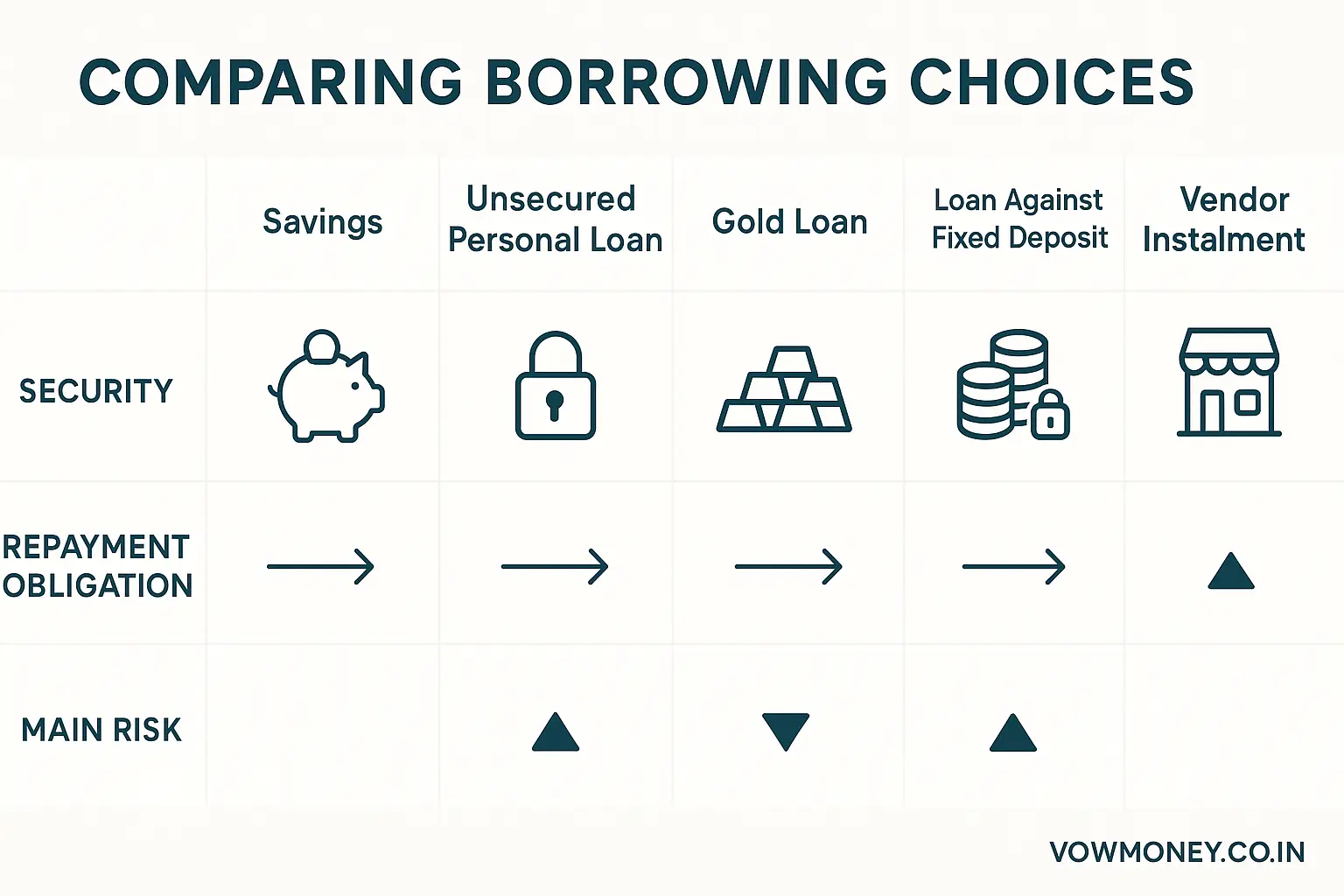
Compare the loan with other ways to meet the funding gap:
| Option | Security | Potential benefit | Main limitation or risk |
|---|---|---|---|
| Savings | None | No interest or EMI | May reduce liquidity and emergency reserves |
| Unsecured personal loan | None | Flexible use and no asset pledge | Interest cost and fixed repayment obligation |
| Gold loan | Gold pledged | Uses an existing asset as security | Repayment failure can put pledged gold at risk |
| Loan against fixed deposit | FD pledged | Borrows against an existing deposit | Amount and terms depend on the deposit and lender |
| Credit-card EMI | Card limit | Convenient for specific transactions | Can become costly or encourage revolving debt |
| Vendor instalment plan | Provider-specific | May align payment with wedding bills | Refund, service and contractual terms need review |
| Family contribution | None | No formal lender charges | May create expectations or family disputes |
A wedding loan may be more manageable when it covers a clearly identified shortfall, the EMI fits alongside existing obligations, and you retain an emergency reserve. Borrowing is riskier for discretionary upgrades, larger venues chosen mainly for status, extra guest counts, expensive décor, gifts or purchases that can be postponed.
A practical affordability test is to add the proposed EMI to existing EMIs and fixed debt payments. Then check whether the remaining income can cover normal living costs, insurance, rent, childcare, post-marriage commitments and emergency savings. This is educational guidance, not a lender rule or universal EMI-to-income threshold.
Digital Wedding Loans: Safety Checks
An app is not necessarily the lender. It may be operated by a bank or NBFC or may act as a Lending Service Provider. Before using an online lending app:
- Find the name of the actual bank or NBFC.
- Verify the relationship on the lender’s official website and relevant RBI resources.
- Check that the KFS and loan agreement identify the regulated lender.
- Avoid unsolicited loan links received through SMS or social media.
- Do not pay unexplained upfront amounts to an individual or unverified app.
- Review privacy permissions and consent requests.
- Confirm the disbursal and repayment channels.
- Save the sanction letter, KFS, agreement, receipts and communications.
The RBI Digital Lending Directions, 2025 set requirements for regulated entities and their lending-service arrangements. RBI has also announced a public directory of digital lending apps associated with regulated entities; use current RBI resources when verifying an app.
What Happens If You Miss an EMI?
A missed EMI may result in disclosed late-payment or penal charges, bounce or mandate-failure charges, collection communication and negative reporting to credit-information companies. RBI guidance on penal charges states that penal charges should be disclosed clearly, should not be treated as penal interest and should not themselves be capitalised for further interest calculation.
CIBIL identifies payment history as an important part of a credit profile. If you expect difficulty, contact the lender before the due date, ask about available procedures and retain written records. Joint borrowers and guarantors should also understand that repayment problems may affect their credit records and liabilities.
If a complaint is not resolved by the lender, the RBI Integrated Ombudsman Scheme may provide a route for eligible complaints after the lender’s grievance process and applicable waiting conditions are followed.
Frequently Asked Questions
Is a wedding loan different from a personal loan?
Usually, a wedding loan is a personal loan marketed for marriage expenses. The exact interest rate, charges, documentation and usage restrictions depend on the lender’s product and agreement.
Can parents take a wedding loan for their child’s marriage?
Parents may apply if they satisfy the lender’s age, income, credit and documentation requirements. Some lenders may permit parents to act as co-applicants, but this is lender-specific and does not guarantee approval.
Can the bride and groom apply jointly?
A joint application may be possible if the lender permits it. Both applicants may be assessed and may share full repayment responsibility, so missed EMIs can affect both credit profiles.
Is collateral required for a wedding loan?
Many bank wedding-loan products are unsecured personal loans, meaning no property, gold or fixed deposit is pledged. However, a marriage-finance product may have a different structure, so check the agreement for security or guarantor requirements.
What credit score is required for a wedding loan?
There is no universal CIBIL score requirement for all lenders. Lenders consider credit history, income, existing obligations, repayment capacity and their own underwriting policies.
What documents are usually required for a wedding loan?
Common examples include PAN, identity and address proof, bank statements, salary slips or income-tax and business documents. Requirements vary by lender, employment type, existing customer relationship and product.
What should I check before accepting a wedding loan?
Check the lender’s identity, KFS, APR, EMI, total repayment, net disbursal, processing fee, taxes, late charges, prepayment terms, usage restrictions and grievance process. Confirm the latest terms directly with the lender before signing.
Final Takeaway
Wedding loans generally work like personal loans: the lender assesses your profile, disburses an approved amount and collects repayment through EMIs. The important decision is not simply whether the loan is available, but whether the total cost and post-wedding repayment obligation fit your finances.
Prioritise savings and planned contributions where possible, borrow only for a defined funding gap and compare the KFS, APR and total repayment before accepting credit. Use VowMoney’s wedding-finance guides and calculators to plan the budget and understand the implications of different funding approaches.
Educational note: Wedding-loan rates, eligibility, approval decisions, fees, repayment terms, end-use conditions, APR, KFS details and prepayment rules vary by lender and borrower profile. Verify the lender’s latest Key Fact Statement, APR, schedule of charges, loan agreement and regulatory disclosures before accepting credit.